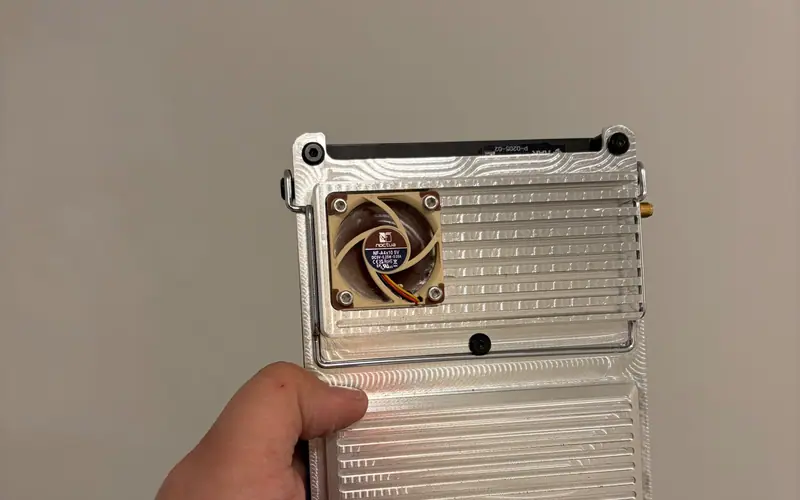
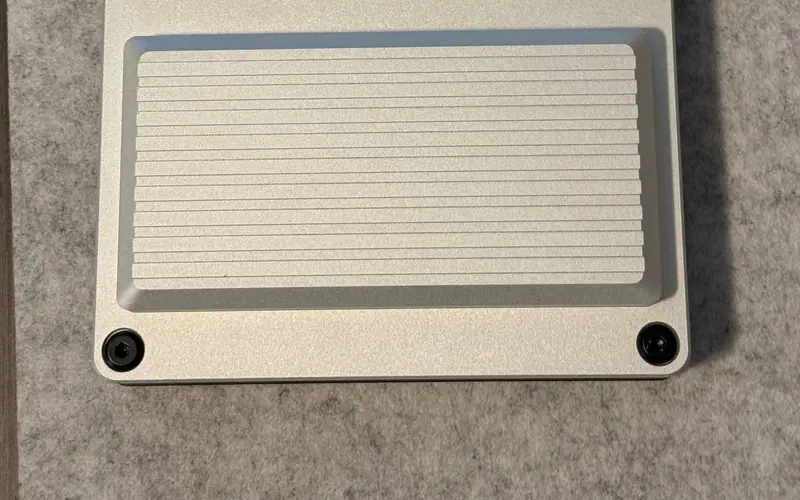
Everyone knows the uConsole gets warm. Fewer people can say what's physically happening, and that turns out to matter, because almost every bad thermal decision comes from a wrong mental picture rather than bad maths.
So here's the picture, without the textbook.
Heat is motion, and your SoC is a heater
Temperature is how vigorously atoms are jiggling. Hot means jiggling hard, cold means jiggling less. Heat is that jiggling spreading from where there's more of it to where there's less.
Which leads to the fact the whole subject rests on: your compute module converts essentially all of its electrical power into heat. Not most. All of it. Nothing meaningful leaves the case as light, sound or motion, so every watt that goes in comes out as jiggling atoms.
A CM4 uConsole at full tilt has been measured by the community at around 6 W. That means a uConsole running flat out heats the room exactly as much as a 6 W resistor does. The computing is, thermally speaking, a side effect.
Once you accept that, the question stops being "why is it hot" and becomes "where do those 6 watts go," which is answerable.
Temperature is the result, not the cause
This is the part that flips most people's intuition, and it's worth sitting with.
The SoC does not have a temperature it "wants." It has a power it must get rid of. It warms up until it's hot enough to push all 6 W out into the world, and then it stops warming up. That's steady state: heat leaving at exactly the rate it arrives.
So temperature is what the chip settles at in order to expel its own power. Make it easier for heat to escape and it settles lower. Make it harder and it settles higher. The chip has no say.
That reframes what a heatsink is. It isn't a thing that "absorbs heat" or "makes things cold." It's a thing that lowers the temperature required to get 6 W out of the box.
The only relationship you need
Every route heat can take has a number attached: how many degrees of temperature difference it costs to push one watt through it. Degrees per watt, K/W.
Push more watts, you need proportionally more degrees:
temperature rise = power × resistance of the path
Paths in series add up, exactly like resistors do - and if that comparison helps you, take it; if not, ignore it, because the arithmetic stands on its own.
For a uConsole the chain runs roughly: silicon → chip package → thermal interface → whatever it touches → case → air. Give each link a K/W figure, add them, multiply by watts, add room temperature. That's your answer.
Illustrative numbers, not measurements:
| Link | K/W |
|---|---|
| Silicon to package | 0.5 |
| Package to interface material | 1.5 |
| Interface to case | 2.0 |
| Case to air | 4.0 |
| Total | 8.0 |
At 6 W: 6 × 8.0 = 48 °C of rise. In a 22 °C room that's 70 °C, which is close enough to throttling territory to explain a great deal.
Two things fall straight out of that table. The biggest number dominates, so the case-to-air step is where your effort belongs. And you cannot fix a late bottleneck by improving an early link - halving the silicon-to-package figure changes almost nothing.
Where 6 W has to go
Every link costs power × K/W degrees; the rises add up end to end. Drag a link and watch the end of the bar. Then try halving the first link, and halving the last one.
- Whole path
- 8.0 K/W
- Rise at this power
- 48 °C
- Silicon settles at
- 70 °C
- Headroom to throttle
- 10 °C
Table view
| Link | K/W | Rise | Hot end |
|---|---|---|---|
| 1 · Silicon to package | 0.5 | +3.0 °C | 25.0 °C |
| 2 · Package to interface material | 1.5 | +9.0 °C | 34.0 °C |
| 3 · Interface to case | 2.0 | +12.0 °C | 46.0 °C |
| 4 · Case to air | 4.0 | +24.0 °C | 70.0 °C |
| Total | 8.0 | +48.0 °C | 70.0 °C |
The three routes, and what actually limits each
Conduction is jiggling passed directly between touching atoms. Aluminium is excellent at it, around 167 W/m·K for 6061.
The metal is essentially never your problem. The joints are. Two surfaces that look flat touch each other across a tiny fraction of their apparent area, and the rest of the gap is air - which at 0.026 W/m·K is a genuinely good insulator, one of the better ones you can get for free.
This is why thermal paste works, and the reason is not the one most people assume. Paste is bad at conducting heat: 3–8 W/m·K, dreadful next to aluminium. It's simply hundreds of times better than the air it evicts. Which also explains why more paste is worse than less. You want exactly enough to fill the gaps and no more, because past that point you're inserting a poor conductor where metal could have been touching metal.
Convection is air touching a hot surface, warming, getting less dense, rising, and being replaced by cooler air. Without a fan this is slow - very roughly 5–10 W/m²·K of surface.
In a fanless device this is usually the real limit. You can make the inside of the machine beautifully conductive and gain almost nothing, because the final handoff to air is what's throttling the chain.
Radiation is infrared light, emitted by everything, all the time. It gets waved away as negligible and at these temperatures, from a decent-sized external surface, it isn't - for a high-emissivity surface it's roughly in the same league as natural convection.
How much a surface radiates depends on its finish, and the numbers are further apart than you'd expect. Bare polished aluminium sits around 0.04–0.09. Anodised aluminium is 0.7–0.9. Anodising roughly doubles what an external surface can shed.
The part we like: clear anodise is nearly as good as black. What your eye registers as colour has very little to do with behaviour in the infrared. Anodising is a thermal decision that happens to also be a cosmetic one, which is a rare and pleasant thing in this line of work.
What the finish does to the outside of the case
Watts leaving one external face of a cover, by convection and by infrared. Switch the finish: only the emissivity changes, and anodising roughly doubles what the surface can shed.
- Emissivity
- 0.80
- Radiation share
- 42 %
- Total leaving this face
- 4.9 W
- Same face, polished
- 2.9 W
Table view
| Finish | ε | Radiation | Convection | Total |
|---|---|---|---|---|
| Polished | 0.05 | 0.13 W | 2.8 W | 2.9 W |
| Clear anodised | 0.80 | 2.1 W | 2.8 W | 4.9 W |
| Black anodised | 0.90 | 2.3 W | 2.8 W | 5.1 W |
A heatsink does two separate jobs
Everything so far is about steady state - where the temperature ends up. That's only half of what a lump of aluminium does, and for a handheld it may be the less interesting half.
Warming something up takes energy in proportion to its mass. Aluminium takes about 900 joules per kilogram per degree. So 100 g of aluminium needs roughly 90 joules to rise one degree.
Your 6 W chip produces 6 joules per second. If that heat is going into the aluminium, you get about 15 seconds per degree of rise.
That's time. Time before you reach the throttle point.
So a heatsink is doing two unrelated things at once. Its thermal path sets where the temperature finally lands. Its mass sets how long you take to get there.
And a uConsole is not a device that runs Cinebench all afternoon. It compiles for ninety seconds and then sits idle while you read the output. For work shaped like that, the mass may buy you more usable performance than the fin area does - you may never reach steady state at all, which makes the steady-state number the wrong thing to have optimised.
This is why "how hot does it get" is an incomplete question. Hot when, doing what, for how long.
How long the metal buys you
The same chip and the same path, with and without extra aluminium. Sustained load ends up in the same place either way; a compile-then-read pattern may never get there.
- Stored per degree
- 115 J/K · 19 s per °C
- Throttle with 100 g
- not in 20 min
- Throttle with no metal
- not in 20 min
- Sustained settles at
- 82 °C
Table view
| Time | With 100 g | No added metal |
|---|---|---|
| 0 min | 22.0 °C | 22.0 °C |
| 1 min | 25.1 °C | 34.8 °C |
| 2 min | 26.7 °C | 39.2 °C |
| 3 min | 26.9 °C | 37.7 °C |
| 4 min | 28.5 °C | 42.1 °C |
| 5 min | 31.2 °C | 50.7 °C |
| 6 min | 31.2 °C | 46.7 °C |
| 8 min | 33.9 °C | 51.8 °C |
| 10 min | 34.9 °C | 48.2 °C |
| 12 min | 38.3 °C | 57.1 °C |
| 15 min | 40.0 °C | 54.9 °C |
| 20 min | 42.7 °C | 52.7 °C |
So what are we actually managing?
Not "make it cold." Silicon is perfectly happy at 80 °C; it isn't suffering and it doesn't need rescuing. Cold is not the goal, and chasing it wastes money and thickness.
Two real goals, and they pull against each other.
One: stay under the throttle point during the work that matters to you. Which requires knowing what work matters. A sustained-load target and a burst target lead to genuinely different designs - one wants a low K/W path, the other wants mass.
Two: keep every surface you touch comfortable. And here's the awkward bit.
You don't sense temperature. You sense how quickly heat flows into your skin. Metal at 40 °C feels far hotter than plastic at 40 °C, because metal delivers heat into your hand much faster - same temperature, completely different experience.
Which means the property that makes aluminium a good heatsink is the same property that makes it feel hot. There's no separating them. A cover that moves heat brilliantly to its outer surface has, by doing exactly what you asked, created a surface that reports every one of those degrees straight into your palm.
So a better cooling solution can make a worse product. Any real target has to include the skin-contact limit, and if you want the actual thresholds, EN ISO 13732-1 is where they live - they're lower for metal than most people guess.
Put it together and the real problem isn't "make it cooler." It's:
Move as many watts into the air as possible, without any surface you touch going past comfortable, while staying within a thickness, weight and cost that still make it a handheld.
That's four constraints arguing. Finding that argument - rather than answering the question you were first handed - is most of the work, and it's the subject of the next article.
What's next
Two follow-ups. One on what engineering is, using the constraint fight above as the worked example, because "make it cooler" collapsing into a four-way trade-off is a much better illustration than anything we could invent.
And one on getting numbers you can trust: hand calculations, simulation, and the bench, and why agreement between all three is the only thing that earns a simulation the right to be believed.
The measured uConsole figures live in that third article. Everything above is the physics you need to know what to measure and why - and if you're mid-build and want something run on our bench in the meantime, ask us. We'd rather the numbers were public than ours.